Pregnancy timeline
Pregnancy milestones week by week
A pregnancy timeline is most useful as orientation. It can explain broad periods of development, likely scan windows, and changing experiences without turning an estimated week into a promise about one pregnancy.
Checked against authoritative sources
Evidence reviewed 7 August 2026 · 13 minute read
General education, not individual medical advice.
The short answer
Pregnancy is conventionally dated as 40 weeks from the first day of the last menstrual period. Development unfolds continuously, so reliable guides use broad ranges and an established clinical due date rather than promising one event on one day.
Gestational timeline
Pregnancy milestones, week by week
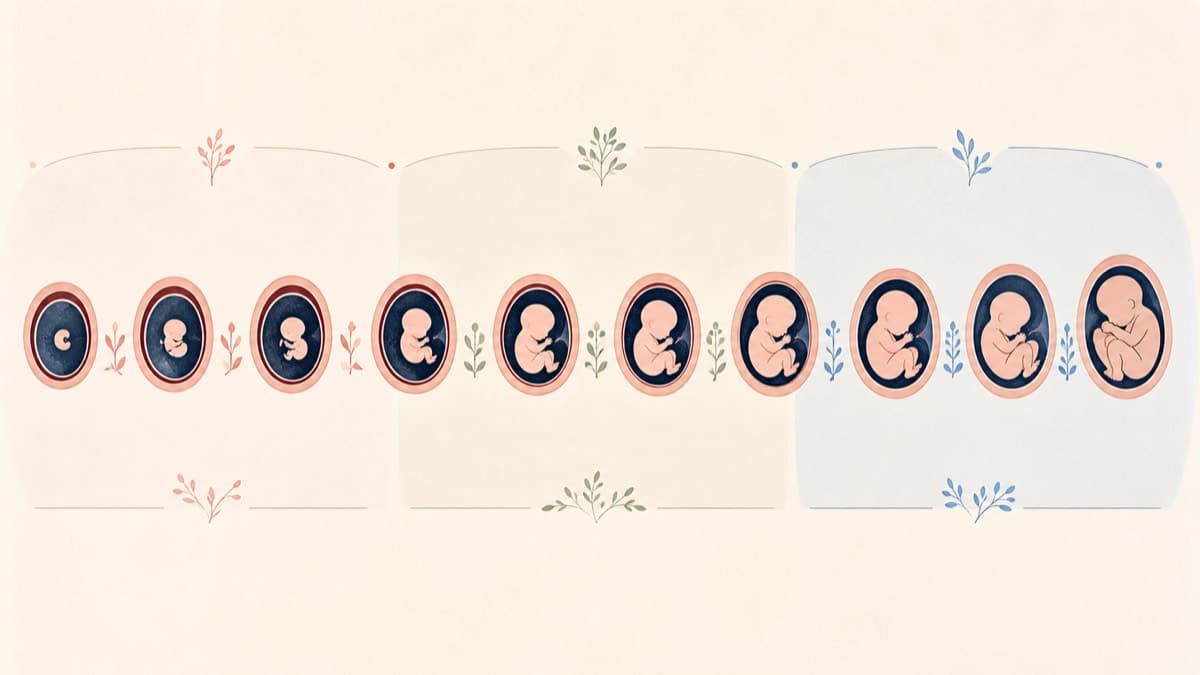
- Week 0Dating beginsThen
- Weeks 16–24Movement often first feltThen
- Weeks 18–21NHS anomaly scan windowThen
- Week 28Third trimester beginsThen
- Week 39Full term beginsThen
- Week 42Postterm begins
Illustrative progression, not to scale. Milestones are ranges, not performance targets.
Safety path
Movement is a pattern, not a universal kick target
- 01Learn the usual patternThere is no single daily number that fits every pregnancy.
- 02Notice a reduction, absence, or changeTrust the change you have noticed.
- 03Contact maternity care immediatelyDo not wait until tomorrow or use a home Doppler for reassurance.
Explore this guide
First trimester milestones
Follow broad first-trimester development from gestational dating through week 13+6, including implantation, early structures, and dating-scan context.
Read the guideSecond trimester milestones
Explore broad second-trimester growth, hearing and movement milestones, plus the timing and limits of the 20-week screening scan.
Read the guideThird trimester milestones
Follow broad third-trimester maturation, movement and term milestones from week 28, with clear guidance for changed fetal movement.
Read the guideBaby movement in pregnancy
Learn when fetal movement is commonly first felt, why each baby has an individual pattern, and when reduced, absent, or changed movement needs urgent contact.
Read the guidePregnancy scans and milestone dates
Understand the different purposes of dating and 20-week scans, what ultrasound can and cannot show, and why scan schedules vary by health system.
Read the guideFree tool
Pregnancy week calculator
Translate an established estimated due date into completed gestational weeks and days, trimester, and a broad milestone range.
Open the toolThe timeline starts with an estimated dating convention
Gestational age is usually counted from the first day of the last menstrual period. ACOG describes an average pregnancy as about 40 weeks from that date, even though fertilization usually occurs roughly two weeks later in a classic 28-day cycle. The extra time is part of the dating convention, not a claim that conception occurred on the first day of bleeding.
A timeline is only as reliable as its anchor. ACOG says first-trimester ultrasound is the most accurate method to establish or confirm gestational age. For pregnancies resulting from assisted reproductive technology, the clinic's ART-derived date should be used. Once a care team establishes the estimated due date, that date should normally replace a self-calculated estimate.
Sources for this section: American College of Obstetricians and Gynecologists, American College of Obstetricians and Gynecologists, NHS.
First trimester: early formation and rapid change
Using ACOG's convention, the first trimester runs from 0+0 through 13+6. Early in this period a blastocyst implants, the embryo stage begins, and structures that will become the brain, spine, digestive tract, face, inner ear, arms, and legs start forming. These processes overlap; they do not wait for a page to change from one numbered week to the next.
During weeks 9 through 12, cartilage, eyelids, nails, and organ functions continue developing. ACOG's infographic calls week 11 the start of the fetal stage when gestational age is used. A dating scan may be offered during this trimester, but the exact schedule and screening choices depend on country, service, personal circumstances, and consent.
Sources for this section: American College of Obstetricians and Gynecologists, American College of Obstetricians and Gynecologists, NHS.
Second trimester: growth, movement, and detailed imaging
ACOG defines the second trimester as 14+0 through 27+6. Bones harden, movements become more coordinated, hearing develops, and body systems continue maturing. A pregnant person may begin to feel movement between 16 and 24 weeks. In a first pregnancy, that first recognized movement may occur after 20 weeks.
In England, the NHS offers a screening scan usually between 18 and 21 weeks to look for signs of specified conditions and check growth. It cannot find every condition, and it is a choice rather than a guarantee. Other countries use different schedules and terminology, so a global milestone calendar should label the jurisdiction instead of presenting one scan window as universal.
Sources for this section: American College of Obstetricians and Gynecologists, American College of Obstetricians and Gynecologists, NHS, NHS.
Third trimester: maturation continues through the final weeks
The third trimester begins at 28+0 under ACOG's convention. The fetus continues gaining weight while the brain, lungs, nervous system, bones, and other organs mature. Movement should remain present through the end of pregnancy and during labor, although the kinds of movement may feel different as space and position change.
The third trimester is not one undifferentiated “term” period. ACOG defines early term as 37+0 through 38+6, full term as 39+0 through 40+6, late term as 41+0 through 41+6, and postterm from 42+0. Those labels describe gestational periods; they do not decide an individual's delivery plan.
Sources for this section: American College of Obstetricians and Gynecologists, American College of Obstetricians and Gynecologists, American College of Obstetricians and Gynecologists, NHS.
Movement milestones include an urgent safety message
There is no single correct number of movements per day. NHS guidance recommends learning the baby's usual pattern rather than comparing it with a generic kick target. If no movement has been felt by 24 weeks, tell the midwife. If movement becomes less frequent, stops, or changes from the usual pattern at any stage after it has been established, call immediately.
Do not wait until the next day, even in the middle of the night. Do not use a home Doppler to decide that the baby is well; hearing a heartbeat does not provide that assessment. A tracker may help someone notice their own observations, but it must never delay contact or mark a concerning change as normal for a particular week.
Call the maternity unit or midwife immediately for reduced, absent, or changed fetal movement. Do not wait for another milestone, a kick target, or the next day.
Sources for this section: NHS.
Use milestones as ranges, not performance targets
A milestone guide describes what commonly develops during a broad period. It cannot determine fetal health, predict exact size, or prove that a structure is normal. Approximate measurements and illustrated comparisons are population-level teaching aids. Ultrasound findings and the care team's interpretation belong to the individual pregnancy and should not be replaced by a generic week page.
Use an established estimated due date to calculate completed weeks and days, then read the relevant trimester or multiweek range. Avoid creating forty repetitive pages that attach one promise to each week. Broader, sourced articles provide the context needed to discuss variation, scans, movement, term language, and when direct care matters more than the calendar.
Sources for this section: American College of Obstetricians and Gynecologists, American College of Obstetricians and Gynecologists, American College of Obstetricians and Gynecologists, NHS Best Start in Life.
Common questions
Why is pregnancy counted before conception?
Gestational age conventionally starts on the first day of the last menstrual period because it is often observable while ovulation and fertilization are not. It does not mean conception occurred that day.
Does every pregnancy reach milestones in the same week?
No. Development is continuous and individual observations vary. Use broad sourced ranges and the pregnancy's clinically established dates rather than treating a week label as a deadline.
When does the second trimester begin?
ACOG starts it at 14+0. Some educational resources group weeks differently, so exact weeks and days are more precise than a trimester label alone.
What should I do if fetal movement changes?
Call the midwife or maternity unit immediately for reduced, absent, or changed movement. NHS guidance says not to wait until the next day.
Sources and review notes
We favour public-health guidance, clinical bodies, official statistics, and original research. Source links are provided so you can inspect the wording and boundaries yourself.
- 01How Your Fetus Grows During PregnancyAmerican College of Obstetricians and Gynecologists
- 02Changes During PregnancyAmerican College of Obstetricians and Gynecologists
- 03Methods for Estimating the Due DateAmerican College of Obstetricians and Gynecologists · May 2017; reaffirmed 2025
- 04Definition of Term PregnancyAmerican College of Obstetricians and Gynecologists
- 05Week-by-week guide to pregnancyNHS Best Start in Life
- 06Your baby's movementsNHS · Last reviewed July 2024
- 0712-week scanNHS
- 0820-week screening scanNHS
- 09Pregnancy due date calculatorNHS · Last reviewed August 2024